A governed operating system for AI-collaborative work.

Launchpad OS is a structured methodology for spinning up fast, auditable AI environments across any domain. This site was built the same way.

Not a tool. Not a template. An operating system.

Launchpad OS is not a tool. It is not a template. It is a governed methodology for AI-collaborative project work: a repeatable operating system that makes AI-assisted projects fast to start, coherent across sessions, and auditable at every stage.

The core problem it solves: AI-collaborative work has no natural structure. Sessions accumulate. Context drifts. Decisions get made twice, or lost entirely. The work is fast in the moment and expensive to recover when it is not governed. Launchpad OS gives that work a spine.

Every project runs the same way. A structured spin-up interview produces a project spec and a scaffold in a single session. Session work follows a defined model: one goal per session, explicit close criteria, a pushed commit or a documented blocker before anything closes. Continuity runs through three documents that carry decisions, session records, and a topic index across every session and across the AI model boundary. The system has been refined across sixteen revisions. It is not experimental. It runs.

  • Fast to start: environment to first commit in a single session, with a live URL before the session closes
  • Coherent across sessions: three continuity documents carry every decision, record, and index across the AI model boundary
  • Auditable at every stage: every session closes with a pushed commit or a documented blocker, logged with actual timestamps

Three domains. One operating system.

Proof 01

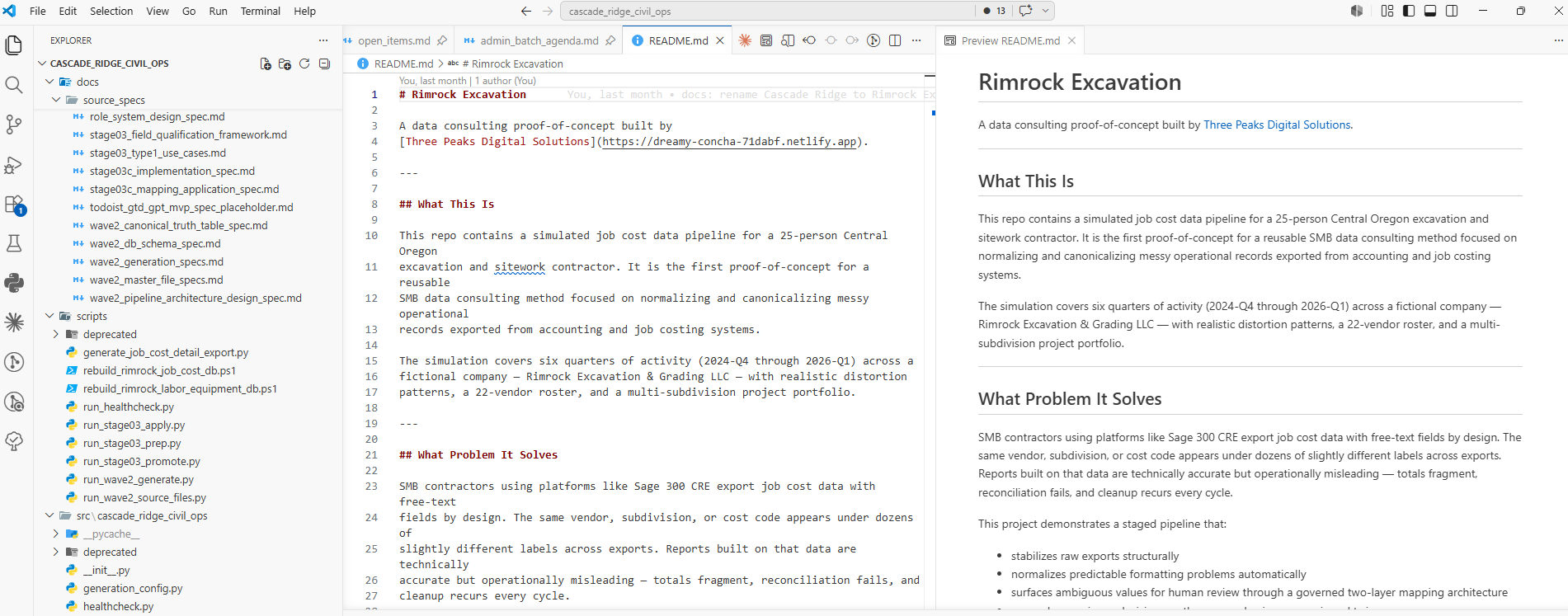
Rimrock

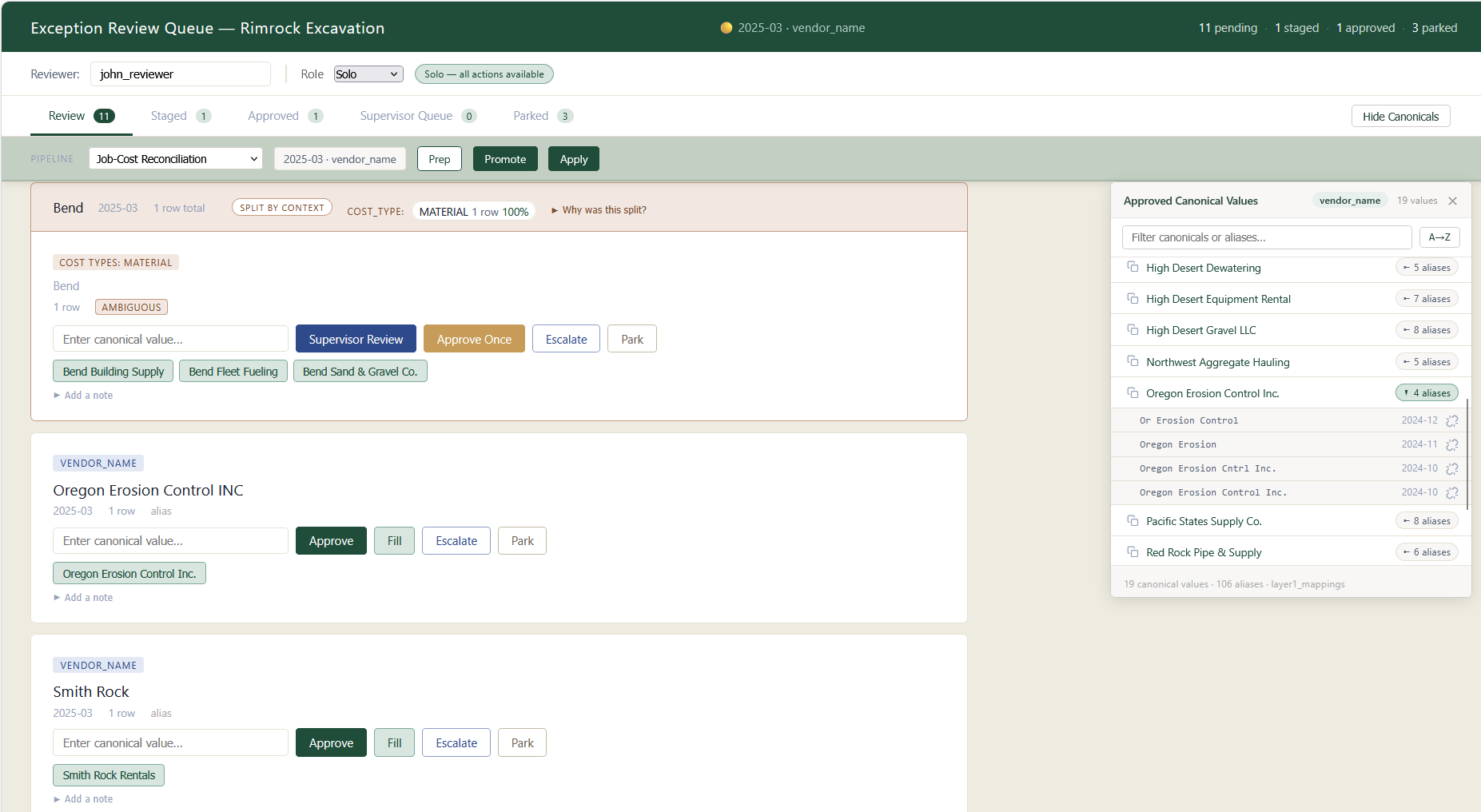
Rimrock is a sitework contracting scenario built to demonstrate Launchpad OS in a data operations context. The contractor is fictional. The data is simulated. The problem it illustrates is not.

The problem: field data from a construction operation arrives unstructured, in inconsistent formats, with no reliable way to tell what is accurate, what is missing, and what is wrong. The goal was to build a pipeline that takes that data and produces something auditable, where every exception is visible, every transformation is traceable, and the output can be handed to a reviewer who was not in the room when it was built.

Launchpad OS governed the entire build: the spin-up interview produced the project spec and scaffold in the first session; each subsequent session had a single defined goal and closed with a pushed commit; the continuity system kept the pipeline logic and decision record intact across sessions. The result is an exception surface: a structured view of every anomaly in the input data, categorized, prioritized, and linked to the transformation that produced it.

Explore the Rimrock demo →

Data operations Exception surface Audit trail
Rimrock exception review queue interface showing the pipeline exception surface with categorized anomalies
Proof 02

Other Nations

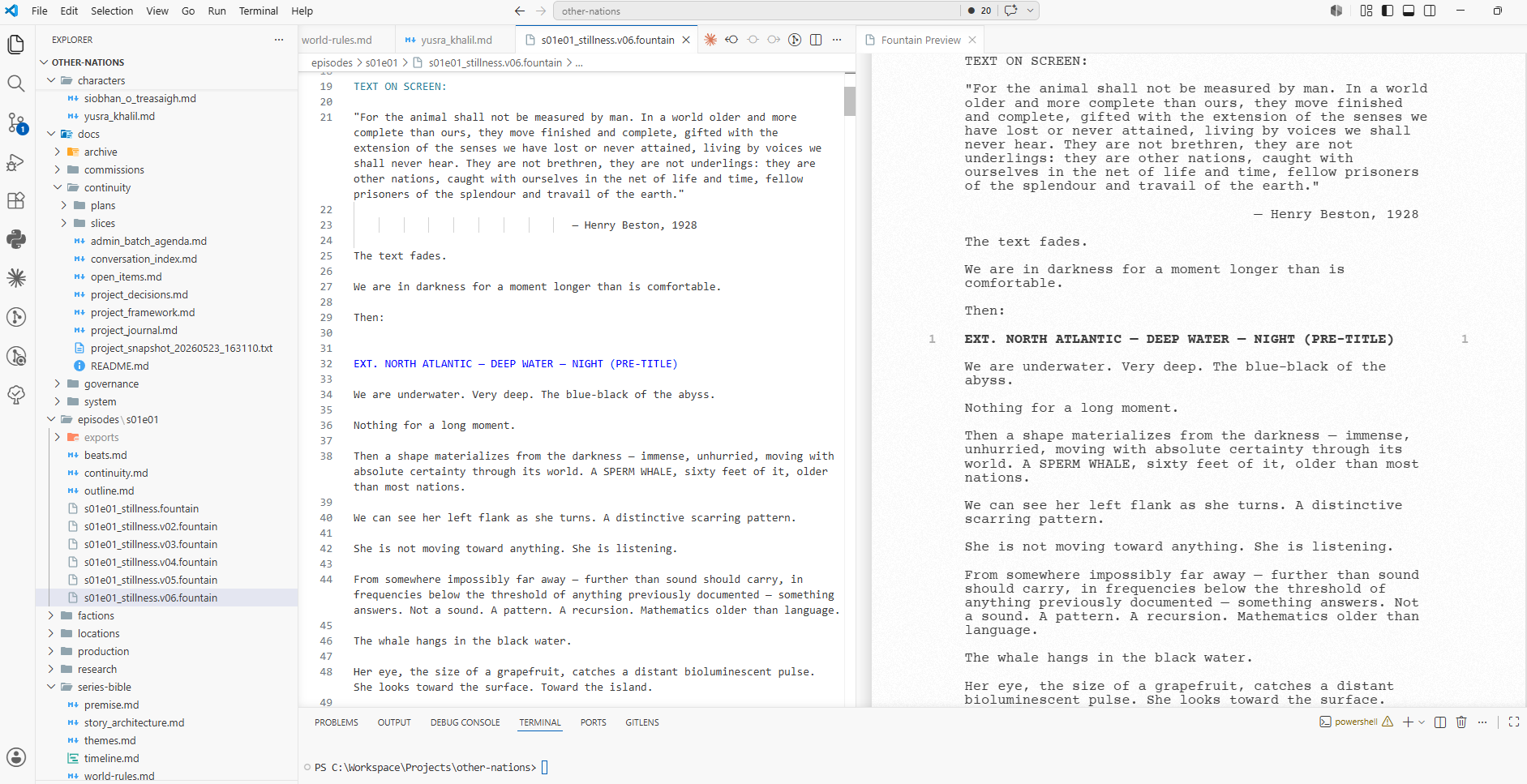
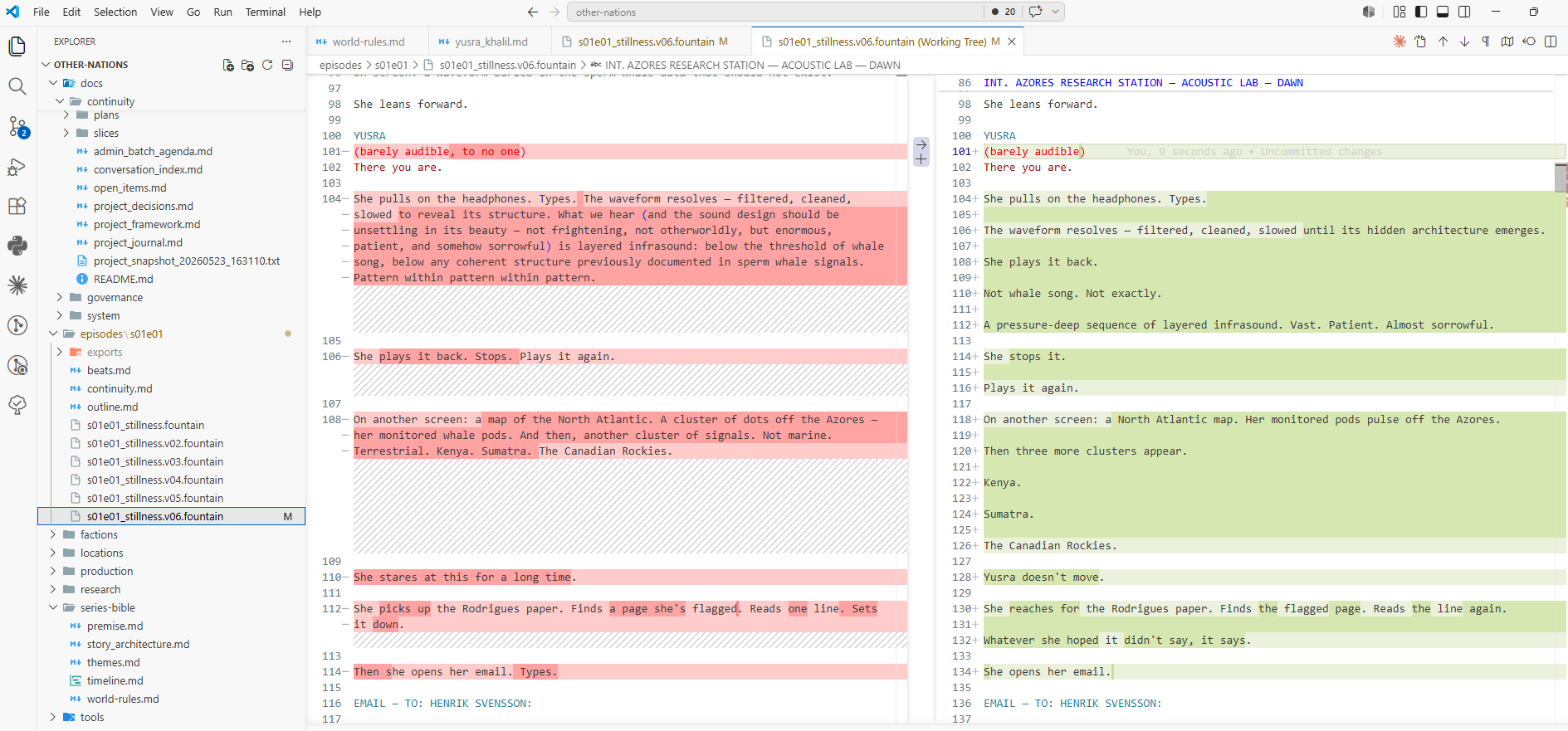
Other Nations is a television drama universe (series bible, episode scripts, character documents, location and faction profiles, and production materials) structured as a software repository. Markdown and Fountain are the source formats. Git handles versioning. The OS was configured for creative production from the same spin-up process used for every Launchpad OS project.

Continuity across a complex world. A multi-season drama universe accumulates decisions fast. World-rules, character history, faction logic, timeline constraints: without a governed continuity system, those decisions scatter. The OS gave every session a structured record of what was settled and why, so a new session could open cold and pick up without reconstruction.

Voice consistency across AI-assisted drafts. AI-assisted creative work has a known failure mode: the prose drifts. The OS counters this by keeping copy discipline and style decisions in the decisions log, available at every session open. Drafts held a consistent register across sessions and across the AI model boundary.

Fast, governed spin-up. The Other Nations environment stood up using the same interview-and-scaffold process documented throughout this site. What changes is the artifact type. The process is the same.

The entire environment runs on free, open-source tooling. No Final Draft license required.

Content (scripts, world documents, story details) is not exposed here. The proof is in the process and the structure: the repository layout, the document types in use, the same three-document continuity backbone adapted to track creative decisions rather than engineering ones.

Creative production Screenwriting Voice consistency
Other Nations repository in VS Code: Fountain script open alongside character files and continuity documents
Proof 03

This Site

You just read about two domains. This is the third.

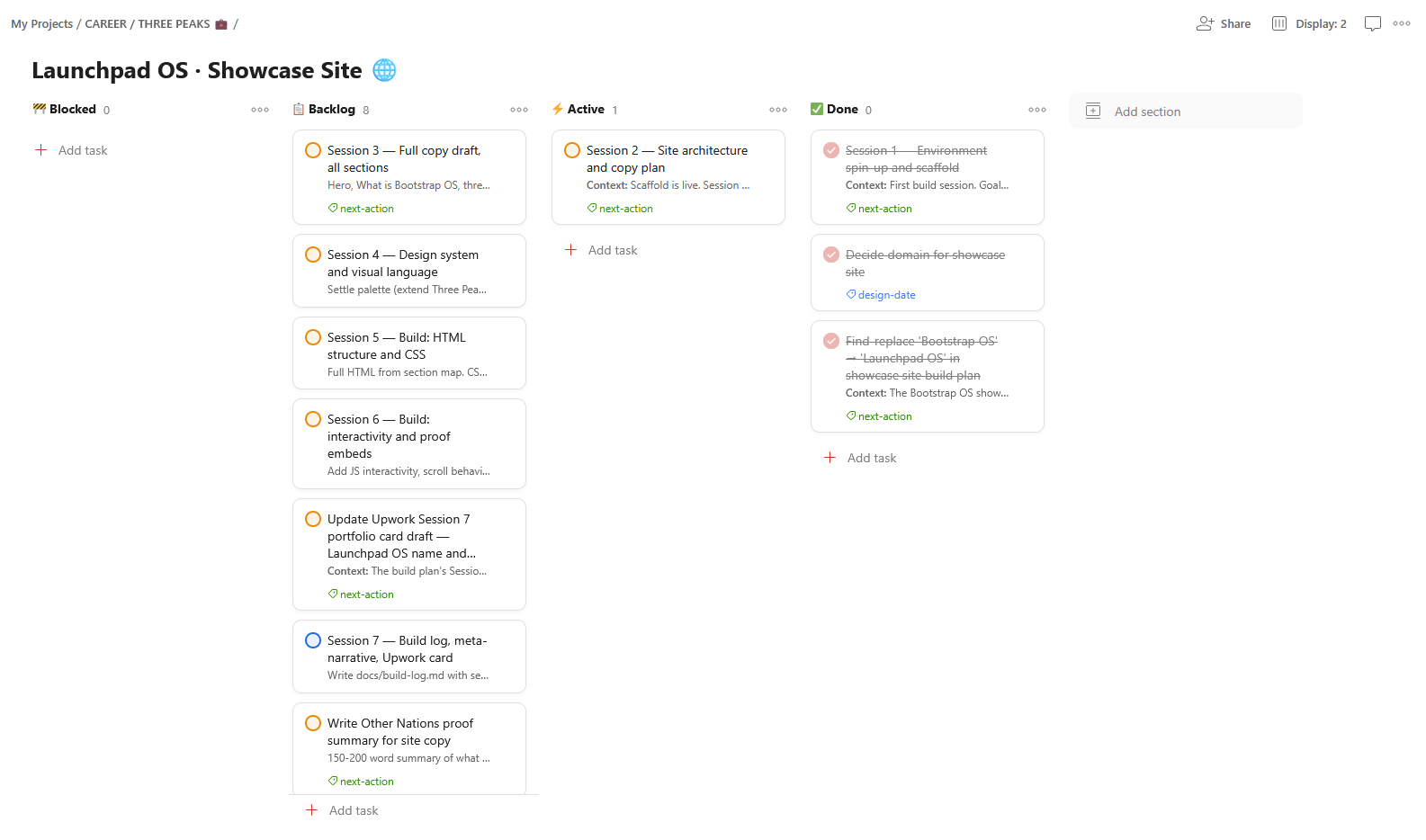
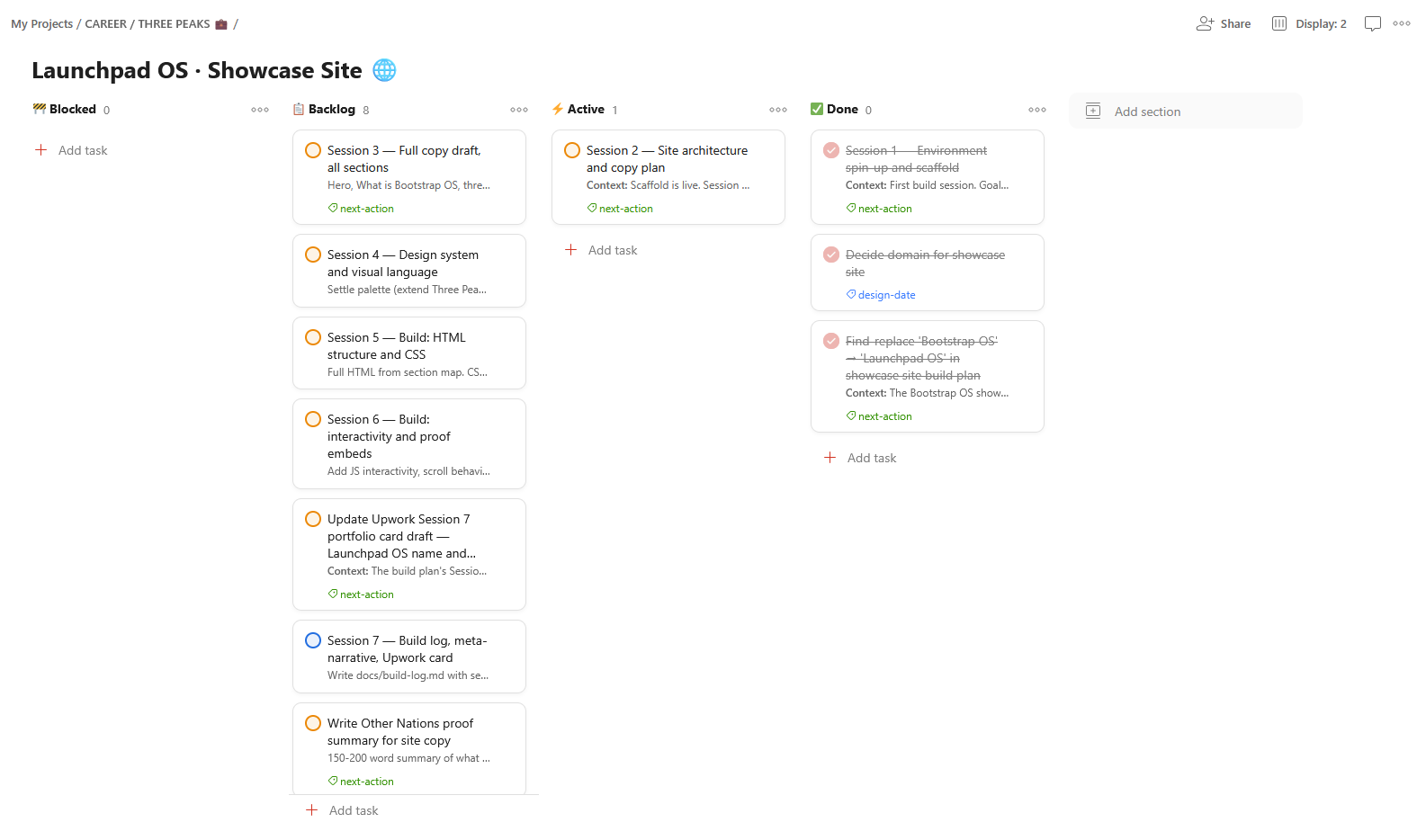
This site was built using the same OS it documents. The spin-up interview happened first. A project spec was produced. A scaffold was committed. A live URL was confirmed. That was Session 1. Everything since (the architecture, the copy, the design system, the HTML and CSS, the build log) has run through the same session model and the same continuity system described in the sections above.

Environment to live URL: under 24 hours. Documented session by session, with actual timestamps, in the build log linked below.

The meta-claim is not a footnote here. It is the third proof. Two domains already demonstrated that Launchpad OS transfers. This site is the professional services proof, and it is the one you are currently reading.

Professional services Under 24 hours Meta-proof
Launchpad OS site repository in VS Code: architecture.md open with file tree visible Launchpad OS Todoist board, four-lane Kanban view of the session-based build workflow

Three elements carry every project.

The spin-up

Every project opens with a structured interview. The interview produces a confirmed project spec: name, scope, folder structure, working mode, governance flags. From the spec, a bootstrap script generates the full scaffold.

  • Directory structure, continuity files, VS Code configuration
  • Initial commit, GitHub remote, live URL
  • Environment to first commit in a single session

The session model

Every session has one goal, stated at open. Close criteria are explicit and agreed before work begins. A session closes when the checklist is fully checked, a commit is pushed, and elapsed time is logged with actual timestamps.

  • No open-ended exploration, no drifting scope
  • If work moves outside the session goal, it is named immediately
  • Blocker entries close sessions where work stalls

The continuity system

Three documents carry every project across sessions and across the AI model boundary. A new session can open cold, load the current position, and work without reconstruction.

  • Project journal: what was accomplished each session and why
  • Conversation index: fast reference for which session covered which topic
  • Decisions log: permanent record of architectural and scope decisions

If you are evaluating AI-collaborative workflow systems for a real project, this is the relevant link.

View my Upwork profile →

Launchpad OS is available for new engagements. The work is fast to start, governed from the first session, and documented throughout. If that matches what you need, the profile is the next step.